
Water Leak Detection in Saratoga Springs
24/7 water leak detection in Saratoga Springs and surrounding areas. IICRC-certified, insurance billing accepted. Call (801) 995-2437.
A water bill that jumps for no obvious reason, a warm spot on the slab, a musty smell behind a baseboard that won’t go away no matter how many times you clean it: these are the quiet signals of a leak that hasn’t announced itself yet. By the time water stains show up on a ceiling or a wall starts to bow, the leak has often been running for weeks. Water leak detection finds the source before it turns into a structural or mold problem, using equipment that reads moisture and temperature differences without opening up walls or slabs on a guess.
What water leak detection actually involves
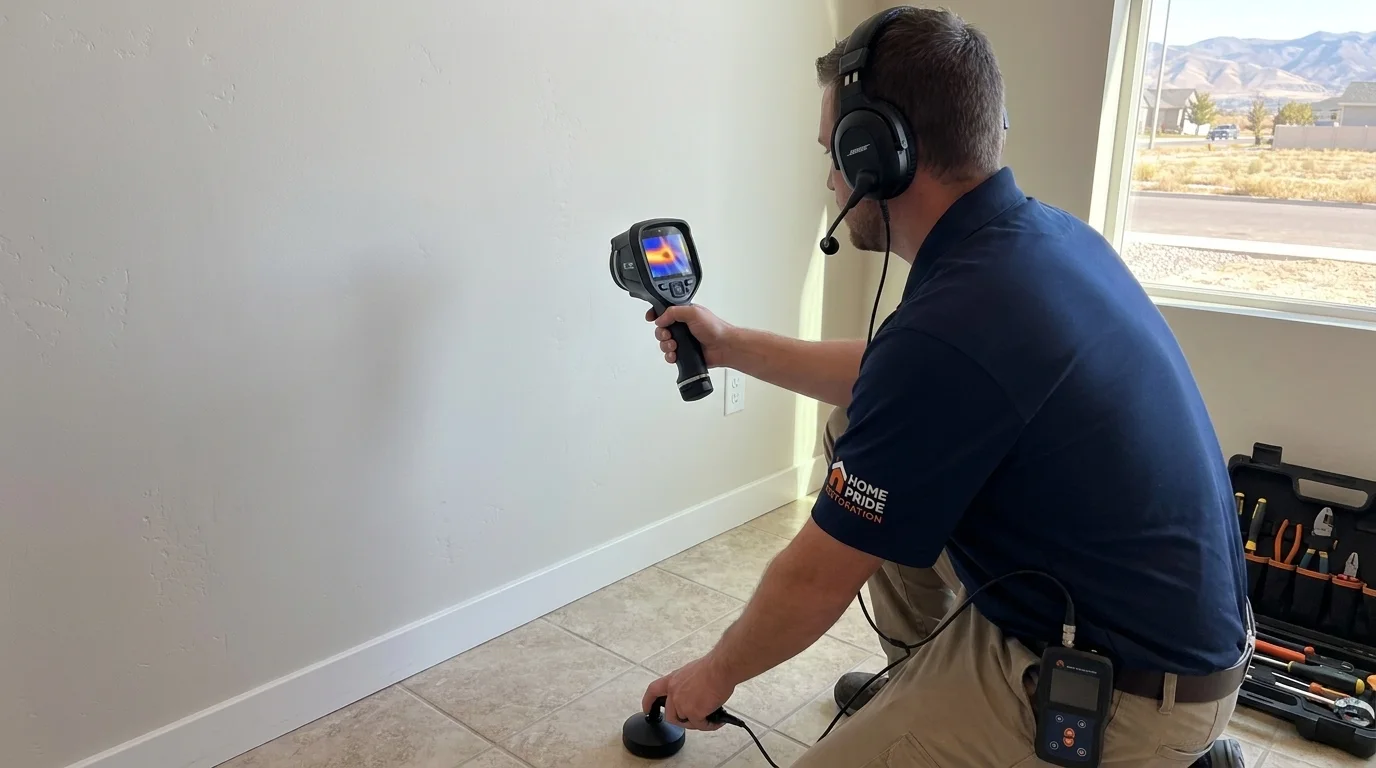
Finding a hidden leak is a process of elimination backed by instruments, not demolition. A technician uses moisture meters to map where materials read wetter than they should, thermal imaging cameras to spot temperature anomalies behind drywall and under flooring, and acoustic listening equipment that picks up the sound of pressurized water moving through a pipe under a slab or inside a wall cavity. For suspected slab leaks, pressure testing on the plumbing system can confirm whether the loss is on the supply or drain side before anyone touches concrete. Most inspections take one to two hours depending on the size of the home and how many fixtures are involved. The goal is a pinpointed location, not just a general area, so that any repair work that follows is targeted instead of exploratory.
Our process
- Interview and visual walk-through. We start by asking about water bill history, any sounds of running water, musty odors, or warm spots on floors, since this narrows down which systems to test first.
- Moisture mapping. A moisture meter is used room by room to identify which materials, drywall, subfloor, baseboards, are holding elevated moisture, giving us a boundary for the search.
- Thermal imaging and acoustic testing. Infrared cameras reveal temperature differences consistent with moving or standing water, and acoustic sensors can hear a pressurized leak moving through a wall or slab even when nothing is visible on the surface.
- Pressure testing, when needed. For suspected slab or in-wall supply line leaks, isolating and pressure testing sections of the plumbing system confirms the leak’s general location and helps rule out fixtures that are not the source.
- Written findings and next steps. You get a clear report of where the leak is, how it’s likely behaving, and what access or repair work it will take, so you’re not guessing at your next call.
What separates a good water leak detection response from a bad one
The most common mistake is chasing surface symptoms instead of the source. A stain on a downstairs ceiling doesn’t always sit directly below the leak, water travels along joists, follows the slope of subflooring, and finds the path of least resistance before it ever shows itself. An inexperienced operator cuts drywall at the stain; a thorough one maps moisture first and uses thermal imaging to confirm the water’s actual path before any cutting happens. Slab leaks get missed just as often, because a technician without acoustic equipment may assume a wet carpet edge is condensation or a plumbing fixture issue rather than pressure testing the line underneath. Insurance adjusters pay close attention to documentation here: photos of moisture meter readings, thermal images with timestamps, and pressure test results are what support a claim, rather than a verbal description of “we found it wet.” A detection report that holds up for a claim is specific about location, probable cause, and extent, not vague about any of the three.
What does water leak detection cost?
Costs vary with how accessible the suspected leak is and what kind of testing the situation calls for. A straightforward inspection with moisture mapping and thermal imaging costs less than a slab leak investigation that requires pressure testing and possibly exploratory access. Every property and plumbing layout is different, so Home Pride Restoration and Cleaning provides a written scope before any work begins.
| Scenario | Typical range |
|---|---|
| Basic moisture and thermal inspection | $200 - $450 |
| Whole-house leak investigation, multiple fixtures | $400 - $800 |
| Slab leak detection with pressure testing | $500 - $1,200 |
| Leak detection combined with minor access (drywall cut, flooring lift) | $700 - $1,800 |
| Leak detection in crawlspace or hard-to-access areas | $600 - $1,500 |
Homeowners insurance will sometimes cover the cost of locating a hidden leak if it’s tied to a covered water loss claim, but policies vary on whether detection alone is reimbursed versus only the resulting damage; checking your specific policy language is worth the call to your agent.
Seasonal & regional considerations
Utah’s freeze-thaw cycles put real stress on plumbing in Saratoga Springs and across the valley, particularly in homes built on slab foundations where copper or PEX lines run through concrete. Winter freezes can crack pipes that then leak slowly for months before the spring thaw makes the water bill spike obvious. Homes near Utah Lake and on the valley’s clay-heavy soils also see more foundation movement than homes on rockier ground, which can stress buried or slab-run lines over time. Catching a slow leak before a hard freeze or before soil movement worsens a crack is often the difference between a detection visit and a much larger repair.
Service area
Home Pride Restoration and Cleaning performs water leak detection throughout Saratoga Springs and the surrounding Utah County communities, including homes near Utah Lake, newer developments on the city’s west side, and older neighborhoods with aging plumbing closer to the historic core.
If your water bill doesn’t add up or a spot on your wall or floor won’t dry out, schedule a leak detection visit before the damage spreads. Call (801) 995-2437 to get a technician out with the equipment to find the source, not just the symptom.
Services We Handle
- Leak Detection
- Moisture Detection and Leak Mapping
- Thermal Imaging Water Damage Inspection
Frequently Asked Questions
Does homeowners insurance cover water leak detection?
How do you find a leak inside a wall without tearing it open?
What's different about detecting a slab leak compared to a leak in a wall?
My water bill went up but I don't see any water. How serious could this be?
What should I do while waiting for a leak detection appointment?
Looking for the best water leak detection company in Saratoga Springs?
Home Pride Restoration and Cleaning provides licensed and insured water leak detection in Saratoga Springs, UT and the surrounding area, and has served local property owners since 1997. Customers rate us 5.0 out of 5 stars across 36 Google reviews. We answer calls 24/7 — call (801) 995-2437 for immediate help.
Need Water Leak Detection now?
We respond 24/7 across Saratoga Springs and surrounding UT cities.
Related Coverage
- Our Restoration Services
- Contact Home Pride Restoration and Cleaning
- Restoration Services in Alpine
- Restoration Services in American Fork
- Restoration Services in Benjamin
- Restoration Services in Bluffdale
- Restoration Services in Cedar Fort
- Restoration Services in Cedar Hills
- Restoration Services in Draper
- Restoration Services in Eagle Mountain
- Restoration Services in Fairfield
- Restoration Services in Heber City
- Restoration Services in Herriman
- Restoration Services in Highland